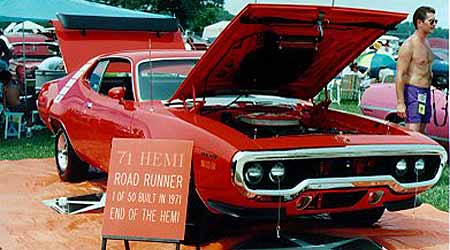
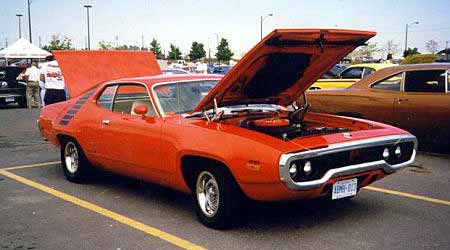
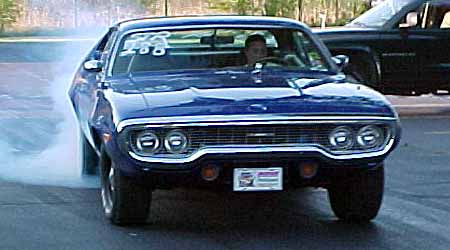
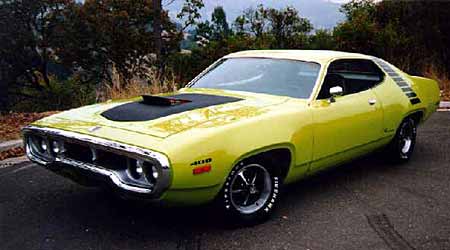
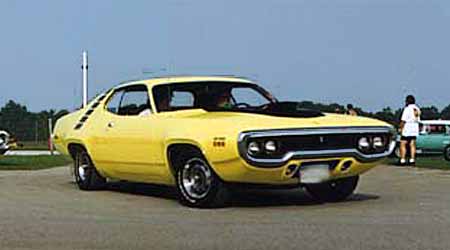
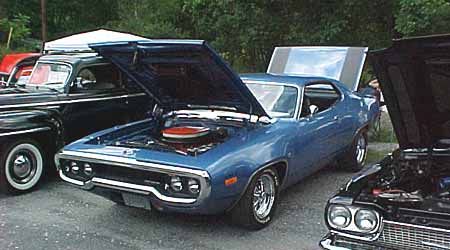
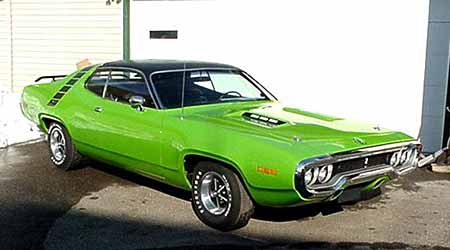
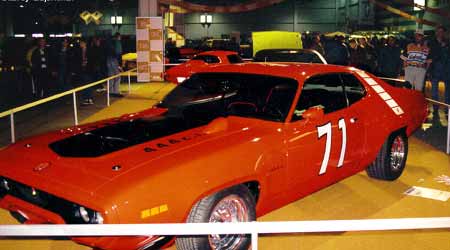
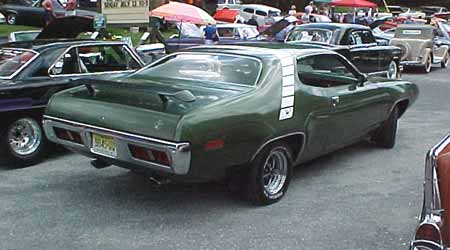
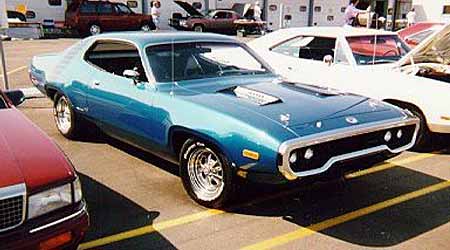
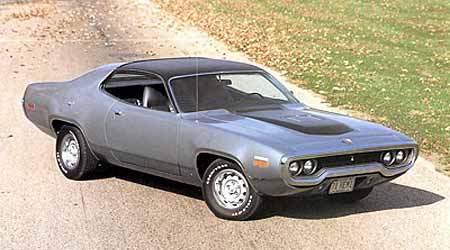
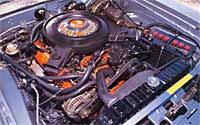
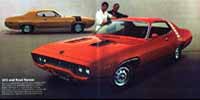
The Plymouth Road Runner of 1971 - 1972 :
1971
:
The RoadRunner model retturned and was based on the two-door Sebring
models.
Unlike the Charger; there was only one body style available on
the Road, a two-door hardtop.
Plymouth wanted the Plymouth to have its
own identity on the outside, even more so than in previous years.
GM's newly
restyled A-bodys demanded that Plymouth update their B- bodies to compete. The
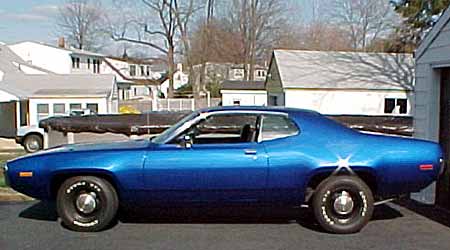
Plymouth now used a lower cowl height to give it that race car look. The four-door
version of both models used a higher cowl position.
Plymouth wanted a
design that blended the sportiness of the Charger's lines while reducing the sharpness.
Herlitz began his design at the roof and worked down.
The roofs crown design
combined with a more steeply angled windshield Bo smoothed the airflow over the
car that the driver and passenger could drive with the windows down and not suffer
the deafening wind noise experienced in other models. This design also proved
beneficial in racing.
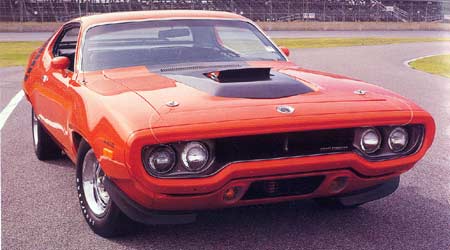
The Plymouth's front end tapered like the front ends
of the 1970 Road Runner and took this design a step further in 1971 with a B-shaped,
chrome, front bumper.
For the first time since its introduction in 1968,
the Road Runner used the same grille as on the GTX. Chrome bumpers were standard
and colored bumpers were available as an option.
Signal lamps were positioned
in the front pan below the bumper.
A colorful bird's head graced the
Road Runner's grille.
Mechanically, if the GTX used the same engine as the
Charger R/T, the engine of the Road Runner was the same as the Super Bee, including
the 340ci V -8 option.
The 440ci Super Commando V-8 was offered as an option
for the Road Runner for the first time in 1971.
Other options for the Plymouths
could usually be found, including front and rear spoilers and a center console,
two types of shift levers, the Air Grabber hood was again available, featured
a raised dome area with a cutout in the middle that housed the trapdoor, and the
words "Air Grabber" appeared on the trapdoor.
1972 :
For
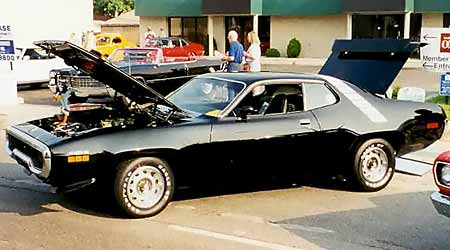
1972 the Plymouth Road Runner stands alone, the GTX did disappeared as a model
to return as an option on the Road Runner, in fact, if a buyer ordered the 440ci
V-8 engine, it came with the "GTX" logo on the deck lid and body sides
and special accent striping.
This appearance set up was also used if a
buyer ordered the 440 si:x-barrel. But it is reported that only one 440-6 was
built.
Plymouth continued to use the body styling it had unveiled in 1971
with natural evolutionary changes. The grille and the tail lamps received small
changed.
The bird's head was eliminated from the grille, but one was placed
inside the circular emblem on the hood filler panel.
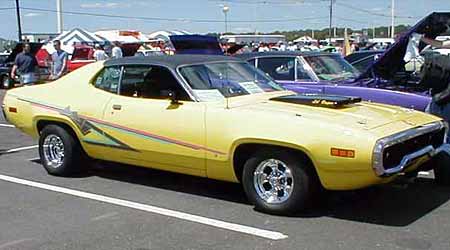
The C-stripe and
fender stripes could not be ordered together. Another stripe used one single center
stripe on the hood and twin stripes on the deck lid. This stripe was only available
on a car ordered with the Air Grabber hood. AIl stripes were available in either
black or white.
Unlike the Charger Rallye, the 1972 Road Runner was standard
with a big block 400ci four-barrel V-8. It was rated at 255 bhp, and 265 bhp with
the Air Grabber.
The 340ci of 240 bhp was again optional.
Options included
a clock, a tachometer, a steering wheel, a vinyl top available in 5 colors, and
a sunroof. AIl engines except the 400 four-barrel came standard with electronic
ignition
Road Runners came standard with the Rallye type suspension.